

How to Train a Golden Retriever Puppy: A Practical Guide
Training a Golden Retriever puppy is a journey of patience, consistency, and love that starts the moment they first tumble through your door. The secret isn't complicated: it's about starting with short, fun sessions focusing on potty training, crate familiarization, and basic commands like 'sit' as early as eight weeks old. This early effort builds a rock-solid foundation for a well-behaved companion for life.
Laying the Foundation in the First Few Months
Bringing home that fluffy, golden bundle of joy is an unforgettable experience. The time between eight weeks and six months is pure magic, a period where your puppy’s mind is a sponge, ready to soak up everything you teach them. This is your golden opportunity to shape a confident, well-mannered family member.
Think of these first few months not as a rigid training boot camp, but as the start of a beautiful conversation between you and your new dog. Your goal is to make learning a joyful game that builds trust and a deep bond.
Puppy Proofing Your Home
Before your little explorer crosses the threshold, you need to get your home ready. Seriously, get down on your hands and knees to see the world from their perspective. What looks tempting to chew? What could be dangerous to swallow?
Your pre-puppy checklist should include:
- Securing electrical cords: Use cord concealers or tuck them safely out of sight. A curious puppy sees these as new chew toys.
- Moving houseplants: Many common plants are toxic to dogs. It’s best to move them out of reach or into another room entirely.
- Locking cabinets: Secure cleaning supplies, medications, and human foods with puppy-proof latches. You would be surprised what they can get into.
- Creating a safe space: Designate a puppy-proofed room or use baby gates to create a secure zone where they can play without you needing to watch them like a hawk.
Creating a Cozy Den With Crate Training
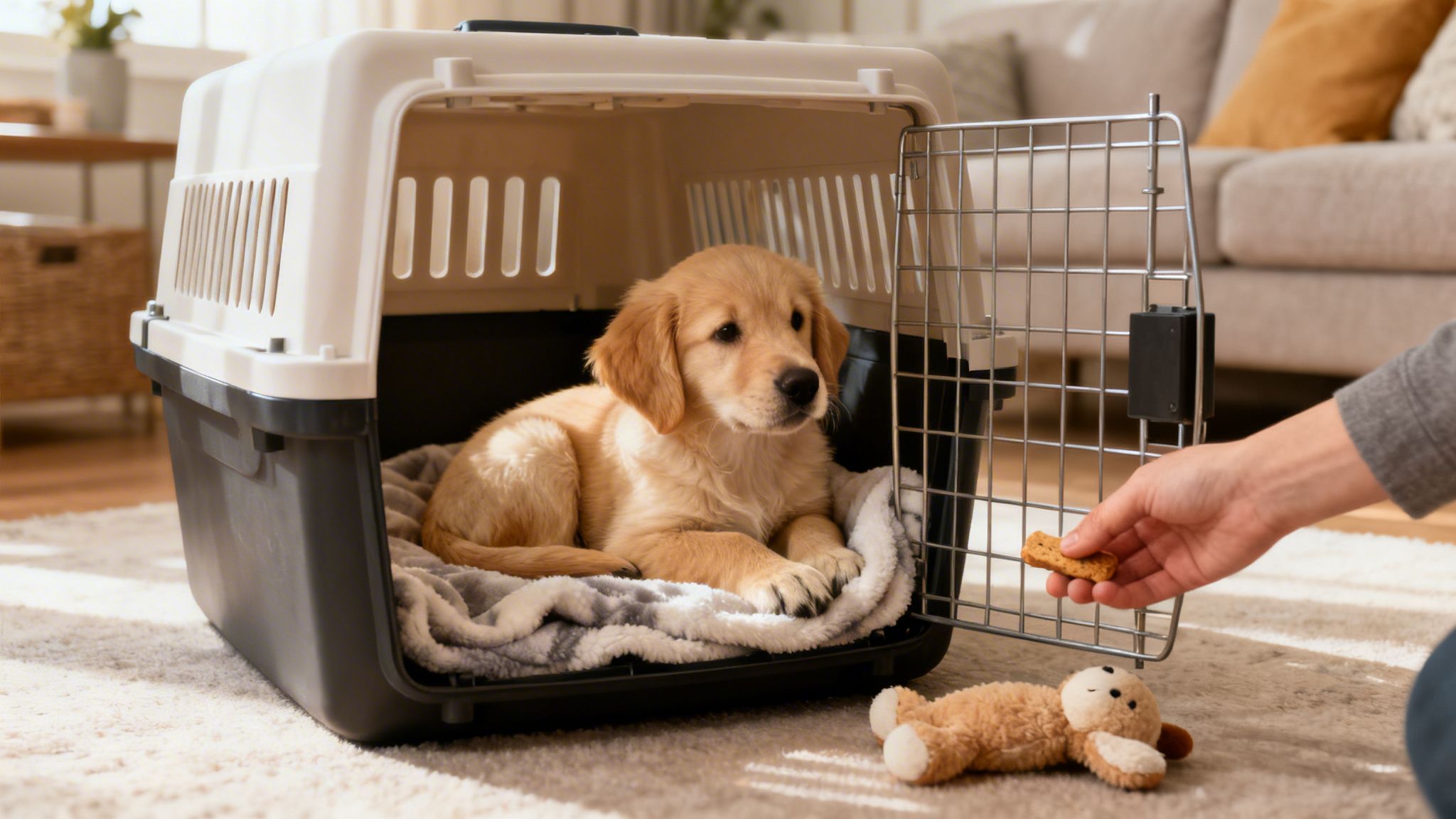
A crate should never be used for punishment. Instead, think of it as your puppy’s personal den, a safe haven where they can relax and feel secure. Make it inviting from day one. Toss a soft bed inside and sneak in high-value treats when they are not looking. For the first few days, just leave the door open so they can explore it on their own terms.
A great trick is to feed their meals inside the crate. Start by placing their food bowl at the very back and letting them eat with the door wide open. After a few times, you can gently close the door for short periods while they eat, slowly extending the time. This forges a powerful positive association, turning their crate into a place of comfort, not confinement.
The Power of an Early Start
Golden Retriever puppies are incredibly smart and genuinely want to please you, which makes them highly trainable from a very young age. Their prime learning window, what I like to call the "Angel Phase," is from two to six months old. During this period, their minds are wired to learn basic obedience and socialization skills at an astonishing rate.
Because Goldens rank an impressive 4th out of 138 breeds in intelligence, they can often grasp commands like 'sit' and 'come' as early as eight weeks old. Starting a gentle, positive training routine right away is the single best thing you can do for their development.
To help you stay on track, here is a quick look at what you should be focusing on as your puppy grows.
Golden Puppy Training Milestones: 8 Weeks to 6 Months
This timeline provides a quick-reference guide to the key training goals to focus on during your puppy's first few months at home.
| Age | Primary Focus | Key Skills to Introduce |
|---|---|---|
| 8-10 Weeks | Foundation & Bonding | Crate training, house training schedule, basic socialization (sights/sounds), name recognition. |
| 10-12 Weeks | Basic Obedience & Manners | "Sit," "Come" (recall), intro to leash/collar, discouraging biting/nipping. |
| 3-4 Months | Socialization & Reinforcement | Safe exposure to new people/dogs, "Stay," "Down," leash walking basics (loose leash). |
| 5-6 Months | Adolescence & Proofing | Strengthening commands in new environments, "Leave it," polite greetings (no jumping). |
Remember, every puppy learns at their own pace. This table is a guide, not a strict deadline. The key is consistent, positive practice.
A consistent schedule is your best friend during these early months. Puppies thrive on routine, from potty breaks and mealtimes to naps and playtime. A predictable day helps them feel secure and makes training concepts like housebreaking click much faster.
To keep everything organized, from vet appointments to training wins, using a dedicated planner can be a lifesaver. You can keep track of your puppy's progress and daily routines by using a notebook like The Golden Plan. This helps everyone in the family stay on the same page, ensuring your puppy receives consistent signals and care. After all, consistency is what turns good intentions into great results.
The Real Deal on House and Crate Training
Let's talk about the big one: house training. It’s the first major hurdle for every new puppy parent, and it can feel a little daunting. The great news? You’ve chosen a Golden Retriever, a breed that genuinely wants to please you, which gives you a huge head start. The secret here isn’t some magic trick; it’s just a simple, powerful mix of consistency, sharp observation, and a whole lot of patience.
The key is to think proactively, not reactively. You want to take your puppy out so often that they barely have a chance to even think about having an accident inside. This builds the right habits from day one and sets them up for a lifetime of success.
Building a Bulletproof Potty Schedule
A young puppy’s bladder is tiny, and they have very little control. I always tell my clients to use the "month-plus-one" rule: a puppy can generally hold it for about one hour for every month of their age, plus an extra hour. So, for your eight-week-old (two-month) pup, that’s about three hours, tops. Don't push it.
Your daily schedule should be built around the times a puppy is almost guaranteed to need a potty break:
- Right after waking up: This means first thing in the morning and after every single nap, no exceptions.
- A few minutes after eating or drinking: Their little systems work fast. Expect a trip outside within 15 to 30 minutes of any meal.
- During and after a play session: All that excitement gets things moving! It's a great idea to take a potty break right in the middle of a good romp.
- Just before bed: One last chance to empty the tank before settling in for the night.
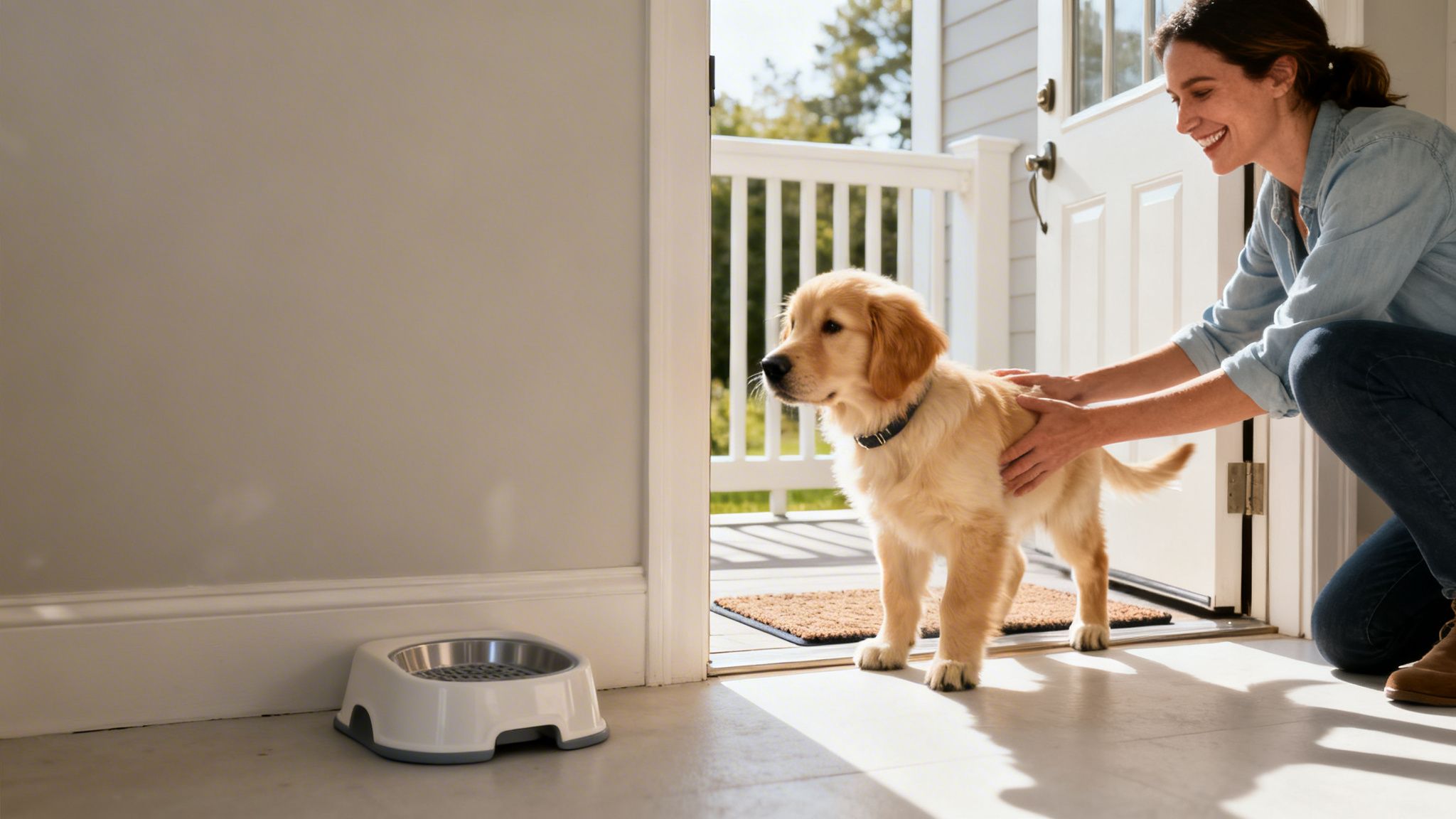
When you take them out, pick a spot and use a consistent cue like "go potty" in a calm, happy voice. The second they finish, throw a mini-party! Lavish them with praise, pets, and a tasty treat. This makes it crystal clear that they did the right thing in the right place.
Reading the Signs and Handling the Inevitable Accident
Your puppy will try to tell you when they need to go. Learning to read their signals is a total game-changer. Look for the classic "potty dance": frantic sniffing, circling, whining, or making a sudden beeline for the door. The instant you see it, scoop them up and get outside.
Accidents are going to happen. It is just a part of raising a puppy. The most important thing is how you react. Never punish them or rub their nose in it. That old advice is terrible; it just teaches your puppy to fear you and can make house training a nightmare.
If you catch them in the act, make a quick, sharp noise (like a clap) to interrupt them, then immediately hustle them outside to finish. If you find the mess later, just clean it up. The non-negotiable tool here is an enzymatic cleaner. Standard soaps cannot break down the odor molecules that essentially scream, "This is a great bathroom spot!" to your puppy.
Remember this: Every accident is a human error, not a puppy failure. It just means you missed a cue or waited a bit too long. Take a breath, adjust your schedule, and watch them a little more closely.
The Crate: Your Puppy's Safe Haven
Crate training is one of the best gifts you can give your Golden. It's not about punishment; it’s about giving them their own personal den, a safe, cozy space that’s all theirs. Dogs have a natural instinct to keep their "den" clean, which makes the crate an incredibly effective house-training tool.
The trick is to make the crate the best spot in the house from the very beginning.
- Start by tossing high-value treats inside and letting your puppy wander in and out on their own with the door wide open.
- Begin feeding them their meals in the crate. This builds a powerful positive connection. Start with the door open, then slowly begin closing it for a few minutes while they eat.
- Designate a special, high-value chew toy that they only get when they are in their crate.
Keep the initial sessions super short, just a few minutes, and gradually extend the time as they get more comfortable. Pretty soon, you'll see your puppy choosing to go into their crate for a nap all on their own. It becomes their private retreat and is invaluable for keeping them safe when you cannot be there to supervise. You can make their space even cozier with some of our Golden Retriever themed home goods, like a soft blanket that smells like you.
Teaching Essential Obedience and Leash Manners
A well-behaved Golden Retriever is an absolute joy, the kind of dog you can confidently take anywhere, from a bustling farmer's market to a quiet patio cafe. This is where we lay the groundwork, teaching them the core skills that make that life possible. We are going to build a common language between you and your pup, turning training into a fun game rather than a chore.
The secret? Keep it short, sweet, and positive. A puppy's attention span is bright but brief, so think in terms of three to five-minute sessions scattered throughout the day. This keeps them engaged and excited to learn, preventing the frustration that can shut down a training session fast.
Mastering the Basic Commands
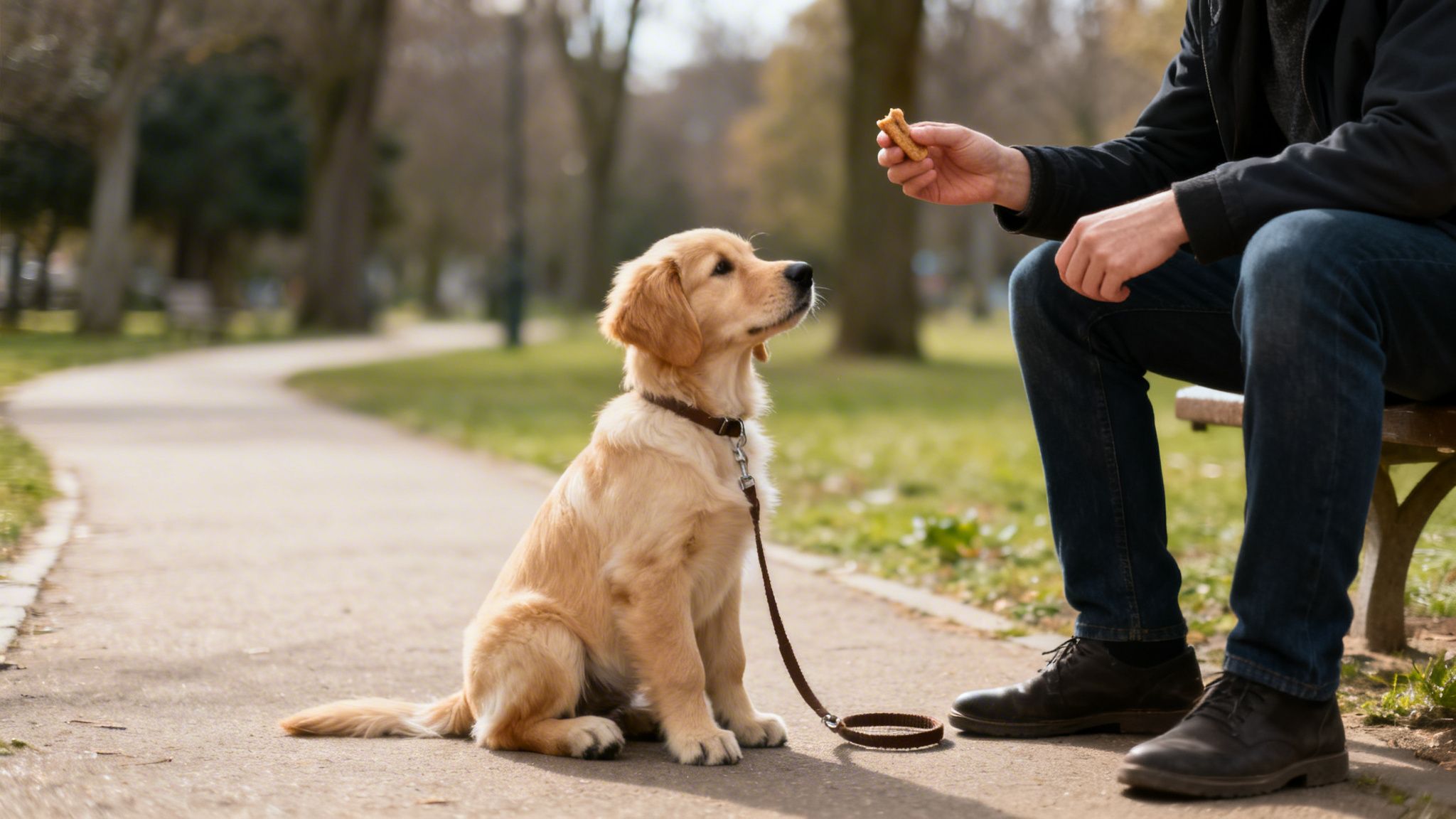
Golden Retrievers are famously food-motivated, which is fantastic news for us. We can use small, high-value treats to our advantage and make learning feel like the best game ever. These foundational cues are the building blocks for a lifetime of good manners and, most importantly, safety.
1. "Sit": The Gateway Command This is often the first real "trick" a puppy learns. To teach it, hold a tasty treat near your puppy's nose and slowly guide it backward over their head. As their head tilts up to follow the treat, their bottom will naturally lower to the floor. The second it touches down, say an enthusiastic "Yes!" and give them the reward.
2. "Down": Building Calmness Once "sit" is solid, "down" is the next logical step. Start by asking for a sit. Then, lower a treat from their nose straight down between their paws. Their natural instinct will be to follow it with their head, and eventually, they will lie down to get closer. Mark the instant their elbows hit the floor and reward them.
3. "Come": A Lifesaving Recall Honestly, this is the single most important command you will ever teach. Start in a quiet, boring room. In an excited, happy voice, say your puppy’s name followed by "Come!" Praise them like crazy the second they start moving toward you. When they arrive, make it a jackpot, lots of treats, praise, and affection. A crucial rule: never call your puppy to you for something unpleasant, like a bath or nail trim.
4. "Leave It": The Impulse Control Cue This command is a potential lifesaver, teaching your pup to ignore dangerous dropped items. Place a boring piece of kibble on the floor and cover it with your hand. Let them sniff and lick your hand. The moment they pull their head back, even for a split second, mark it with "Yes!" and give them a much better treat from your other hand.
Keeping Training Fun and Effective
Remember, you are working with a baby animal. Their brain is a sponge, but it gets full fast. A successful training plan is built on positive experiences that leave them wanting more.
Here’s how to set your puppy up for success:
- Keep it short: Multiple 3-5 minute sessions are far more effective than one long, draining one.
- End on a high note: Always finish with a command your puppy knows and performs well. This builds their confidence for the next session.
- Use a marker word: A short, sharp word like "Yes!" or a clicker pinpoints the exact moment your puppy does the right thing, making it crystal clear what earned them the reward.
Pro Tip: Your puppy’s daily food ration is a powerful training tool. Measure out their breakfast and use that kibble for your morning training sessions instead of dumping it all in a bowl. This ensures they are motivated and prevents overfeeding.
Teaching Polite Leash Manners
Nothing beats a relaxing walk with your dog. But a puppy who pulls can turn that pleasant stroll into a frustrating game of tug-of-war. The goal here is simple: teach your puppy that a loose leash makes the walk happen, and a tight leash makes it stop.
Start inside where distractions are minimal. Just put their collar and leash on and let them drag it around for a few minutes. This helps them get used to the feeling without any pressure.
When you are ready to practice, grab the leash and a handful of treats. The moment the leash goes slack and your puppy is near your side, give them a treat. If they forge ahead and the leash tightens, just stop walking. Stand still and silent like a tree. The second they release that tension, even just by looking back at you, say "Yes!" and reward them.
This teaches a simple but powerful lesson: a tight leash means the fun stops, and a loose leash means good things happen. It takes a lot of patience and repetition, but this method builds a wonderful walking partner for life. Just imagine enjoying your morning coffee from a favorite Golden Prints mug while your well-mannered pup naps peacefully after a perfect walk. That is the beautiful reality we are aiming for.
Socializing Your Puppy for a Confident Future
Let's talk about one of the most crucial parts of raising a great dog: socialization. Many people think this just means a trip to the dog park, but it is so much more. Real socialization is the process of gently introducing your Golden Retriever puppy to all the sights, sounds, and textures of our world, helping them grow into a confident, well-adjusted adult who sees new things as exciting, not scary.
This all happens during an incredibly short, critical window, from about three to sixteen weeks of age. In these few weeks, your puppy's brain is like a sponge, soaking up experiences and forming lifelong opinions. What happens now, good or bad, will genuinely shape the dog they become.
Building a World of Positive Experiences
Your job is to be your puppy's guide, creating positive associations with everything new they encounter. The concept is simple: pair something new and potentially strange with something they already love, like a tasty treat or a fun game. We are not trying to overwhelm them; instead, we are building a bank of small, happy "wins" that boost their courage.
Start right inside your own home. Think about the vacuum cleaner, a terrifying monster to a tiny pup. Do not just flip it on and hope for the best. Have a friend or family member stand with the vacuum across the room while you give your puppy some amazing treats. Have them turn it on for just a second, then immediately praise your pup and give them more snacks. Suddenly, the monster becomes a magic trick that makes chicken appear!
Your Socialization Checklist
Think about all the little things that make up your daily life. Your goal is to introduce your puppy to these things in a controlled, happy way before that 16-week window closes.
Here are a few ideas to get you started:
- Sounds: Gently expose them to the blender, doorbell, hairdryer, and clanging pots and pans. Always pair the noise with something wonderful.
- Surfaces: Let them walk on different textures. Carpet, hardwood floors, cool tile, grass, and even a wobbly cushion can help build their physical confidence.
- People: Arrange for them to meet people of all kinds: tall, short, young, old. Ask friends to meet them calmly, letting the puppy approach first. Introduce people wearing hats, sunglasses, or carrying umbrellas.
- Objects: Let them investigate everyday items like a rolling suitcase, a bicycle, or even holiday decorations at their own pace.
The golden rule of socialization is to never, ever force it. You are a facilitator, not a drill sergeant. Pay close attention to your puppy’s body language. A tucked tail, hiding, or repeated yawning are signs of stress. If you see them, it’s time to back off, create more distance, and slow things down.
Puppy Classes and Safe Dog Interactions
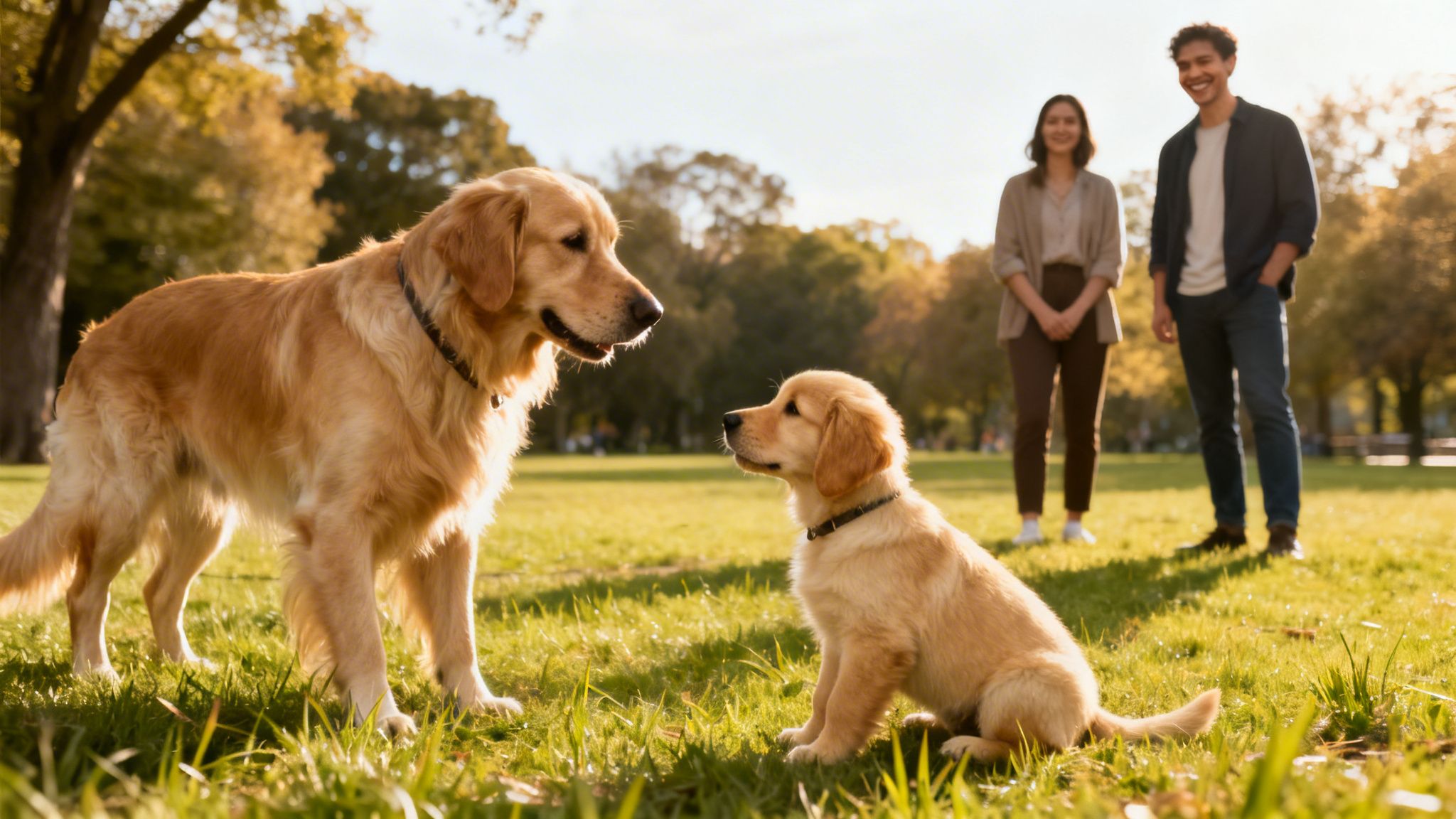
A good puppy socialization class is worth its weight in gold. These are controlled environments where, under a trainer's supervision, your Golden can learn how to "speak dog" with other puppies. This is where they learn crucial skills like bite inhibition, finding out that a nip that's too hard makes the fun stop. Trust me, it is a lesson best learned from another puppy!
When you introduce your pup to an adult dog, choose a friend's dog that you know is calm, patient, and good with puppies. Leashed greetings can create a lot of tension, so a safe, fenced yard is a much better place for a first meeting. Keep it short and sweet, and always end on a high note before anyone gets too rowdy. These early, polite doggy conversations are invaluable for raising a friendly, sociable companion for life.
Tackling the Tough Stuff: Nipping, Chewing, and Other Puppy Shenanigans
Sooner or later, every adorable Golden Retriever puppy will start testing the waters. It is a totally normal part of growing up. Let's walk through how to handle the classic puppy challenges, nipping, chewing, jumping, and barking, not with punishment, but with smarts and a little patience.
Think of it this way: every "problem" is really just your puppy trying to communicate. Our job is to teach them a better way to do it. You are not just correcting a behavior; you are building a stronger, clearer relationship with your new best friend.
The Land Shark Phase: Taming Those Needle-Sharp Teeth
Ah, the "land shark" phase. If you have a Golden puppy, you know exactly what I am talking about. Suddenly, your hands, ankles, and pant legs are public enemy number one for a set of tiny, razor-sharp teeth. First, take a deep breath and remember: this is not aggression. It’s how puppies play and explore their world.
Our main goal here is to teach bite inhibition, which is just a fancy way of saying they learn to control how hard they bite. This is a non-negotiable life skill. The next time your pup gets too mouthy, let out a sharp, high-pitched "Ouch!" and pull your hand away. Freeze completely and ignore them for about 15 to 20 seconds. This is exactly what their littermates would do, and it sends a clear message: "Hey, that hurt! The fun stops when you bite too hard."
Once the brief timeout is over, hand them an appropriate toy. This simple swap teaches one of the most important lessons of puppyhood: hands are for petting, toys are for playing rough.
Surviving the Chewing Crusade
Puppies chew. It’s a natural, necessary part of being a dog, especially when they are teething and their gums are aching. The real trick is managing what they chew. When you find your pup gnawing on a chair leg, it’s not an act of rebellion; it is just them finding the most convenient option.
Your best defense is a good offense. Puppy-proof your home and then give your Golden an all-access pass to a fantastic variety of chew toys.
Here are a few things that work wonders:
- Durable rubber toys: Brands like Kong are classics for a reason. You can even stuff them with a bit of xylitol-free peanut butter or yogurt to make them irresistible.
- Soothing teething toys: Look for toys you can pop in the freezer. The cold provides amazing relief for sore puppy gums.
- Long-lasting chews: Things like bully sticks or dental chews are great for keeping a puppy busy, but always keep an eye on them while they’re enjoying these.
If you catch them in the act with something they should not have, do not panic. Calmly interrupt with a firm "Ah-ah!" and immediately offer them one of their own toys. The second they take the toy, shower them with praise. You are not just stopping a bad habit; you are actively building a good one.
A little expert advice: A bored puppy is a destructive puppy. Often, unwanted chewing is just a symptom of not enough physical and mental exercise. A tired, engaged Golden is a well-behaved Golden.
Putting a Lid on Jumping and Nuisance Barking
It’s cute when a 15-pound fluffball jumps up to say hello. It is not so cute when they are 70 pounds and knocking over your guests. The same goes for barking; what starts as an occasional "woof" can quickly become a real problem. Both of these behaviors usually come from a place of pure, unadulterated excitement or a simple plea for attention.
For the Jumping Bean The rule is simple: four paws on the floor get the attention. When your puppy jumps on you, just turn your back. No talking, no eye contact, no pushing them down. The very instant all four of their paws are back on the ground, turn around and reward them with calm praise and a gentle pat. They will connect the dots surprisingly fast.
For the Barking First, play detective. Why are they barking? Are they bored? Trying to get your attention? Alerting you to a leaf blowing across the lawn? If it’s for attention, the "ignore" method works here, too. If they are bored, redirect that energy into a quick training session or a puzzle toy. For alert barking, you can teach a "Quiet" cue. Let them get one or two barks out, then say "Quiet" in a calm, firm voice while holding a super tasty treat to their nose. They have to stop barking to sniff it, and when they do, they get the treat.
Patience and consistency are your secret weapons here. It’s crucial that everyone in the house is on the same page with the rules. Sometimes having a simple, daily reminder can help, like a fun Golden-themed kitchen towel that keeps your training goals top of mind for the whole family.
Your Golden Retriever Puppy Training Questions Answered
Even with the best game plan, you are going to have questions. You will hit little snags and moments of doubt; that’s just part of raising a puppy. Let's tackle some of the most common worries I hear from new Golden Retriever parents.
Think of it this way: you are not just teaching your pup to sit. You are building a lifelong relationship, and every question you ask helps make that bond even stronger.
How Long Should Our Training Sessions Be?
This is a big one, and the answer is refreshingly simple: keep them short and sweet.
A Golden Retriever puppy has an incredible zest for life, but their attention span is tiny. A focused, successful three-minute session is infinitely better than a frustrating ten-minute one where you both end up discouraged.
Try weaving multiple "micro-sessions" into your day. Practice "sit" for two minutes right before you put their food bowl down. Work on not pulling on the leash for three minutes in the hallway. These little bursts of learning are powerful. They keep your pup excited and engaged, not tired and overwhelmed.
What If My Puppy Isn't Motivated by Food?
It is true, most Goldens would sell their soul for a crumb of cheese. But every now and then, you will meet a puppy who just is not that into treats, especially if they are distracted or feeling a little anxious. If food is not working, do not panic. You have plenty of other tools in your toolbox.
First, double-check that you are using truly high-value treats, not just their boring old kibble. We are talking tiny pieces of boiled chicken, freeze-dried liver, or string cheese. If that still does not do the trick, it is time to figure out what does light them up.
- Praise and Affection: Never underestimate the power of an enthusiastic "Yes! Good boy!" and a happy ear scratch. Goldens live for our approval.
- A Favorite Toy: For some pups, a quick game of tug-of-war or the squeak of a beloved toy is the ultimate prize. Keep a special "training only" toy to make it extra exciting.
- Real-Life Rewards: This is my favorite. Does your puppy want to go outside? Ask for a quick "sit" before you open the door. The reward for sitting is getting exactly what they wanted.
The key is to find your puppy's unique "currency." Training is all about paying them for a job well done. Your job is to figure out what form of payment they value most in that moment.
When Can I Trust My Puppy With More Freedom?
It’s so tempting to let that adorable ball of fluff have the run of the house. But unsupervised freedom is where accidents happen and bad habits, like gnawing on your coffee table, are born. Freedom has to be earned, one room at a time.
A good rule of thumb is to wait until your puppy has been accident-free for at least a full month before you even think about expanding their world. When you are ready, start small. Use a baby gate to give them supervised access to one new, puppy-proofed room.
If they handle that beautifully for a week or two with no potty mistakes or chewing mishaps, you can gradually introduce another area. This slow, steady approach is how you set them up for long-term success and protect your home from puppy chaos. Honestly, many Goldens are not fully trustworthy with complete freedom until they are closer to a year old, and that is perfectly normal.
Thinking about all the joy your pup brings to your life? You might get a kick out of our guide on the best gifts for dog owners, which is full of ideas that celebrate this amazing bond.
Training a Golden Retriever puppy is an incredible process, full of learning for both of you. Celebrate the small wins, have patience through the messy parts, and cherish every single moment. For apparel, home goods, and gifts that honor the golden life, explore the full collection at Golden Prints. https://www.goldenprintsonline.com


