

Making Homemade Dog Jerky Your Golden Retriever Will Crave
You know that full-body wiggle your Golden Retriever does when you reach for a special treat? It’s one of the best parts of being a dog parent. Making homemade dog jerky is a surprisingly simple way to take that happy dance to a whole new level. It is about giving your best friend a high-value, single-ingredient snack that is both unbelievably tasty and genuinely healthy.
Why Homemade Jerky Is the Perfect Treat for Your Golden
When you look at your Golden’s happy face, you want to give them the absolute best. Let's be honest, store-bought treats often have long, confusing ingredient lists packed with preservatives and fillers you cannot even pronounce. Making jerky at home puts you in the driver's seat, ensuring your dog gets a pure, protein-packed reward without any of the junk.
This is not just about avoiding the bad stuff; it is about adding more of the good. For a breed as active as a Golden Retriever, high-quality protein is essential for maintaining lean muscle and fueling their endless energy. Homemade jerky delivers exactly that.
It turns out, we are not alone in wanting this level of quality. The global market for pet jerky treats is booming, expected to hit USD 6.72 billion by 2035, mostly because 85% of owners now consider their pets true family members. This shift is exactly why so many of us are turning our kitchens into small-batch treat bakeries. You can learn more about the rise of premium pet treats.
For our family, making jerky has become a weekend ritual. The smell fills the house, and our Golden, Cooper, parks himself by the oven, acting as the official "quality control supervisor." It is a simple project that brings us all a little closer.
Ultimately, this process gives you total peace of mind.
- You control every single ingredient. This is a game-changer, especially if your Golden has food sensitivities or allergies. Say goodbye to mystery meats or hidden grains.
- It is a high-value training reward. The rich, meaty flavor makes jerky an irresistible incentive for reinforcing good behavior, from nailing recall practice at the park to greeting guests calmly at the door.
- It is a meaningful gift. A jar of homemade jerky, perhaps paired with a cute Golden Prints kitchen towel, makes a heartfelt and practical gift for any dog lover in your life.
Choosing the Best Meats and Safe Ingredients
The secret to incredible homemade dog jerky starts long before you turn on your dehydrator. It begins right at the butcher counter. Picking the right protein is the most important step for making a safe, delicious treat that your Golden will go nuts for.
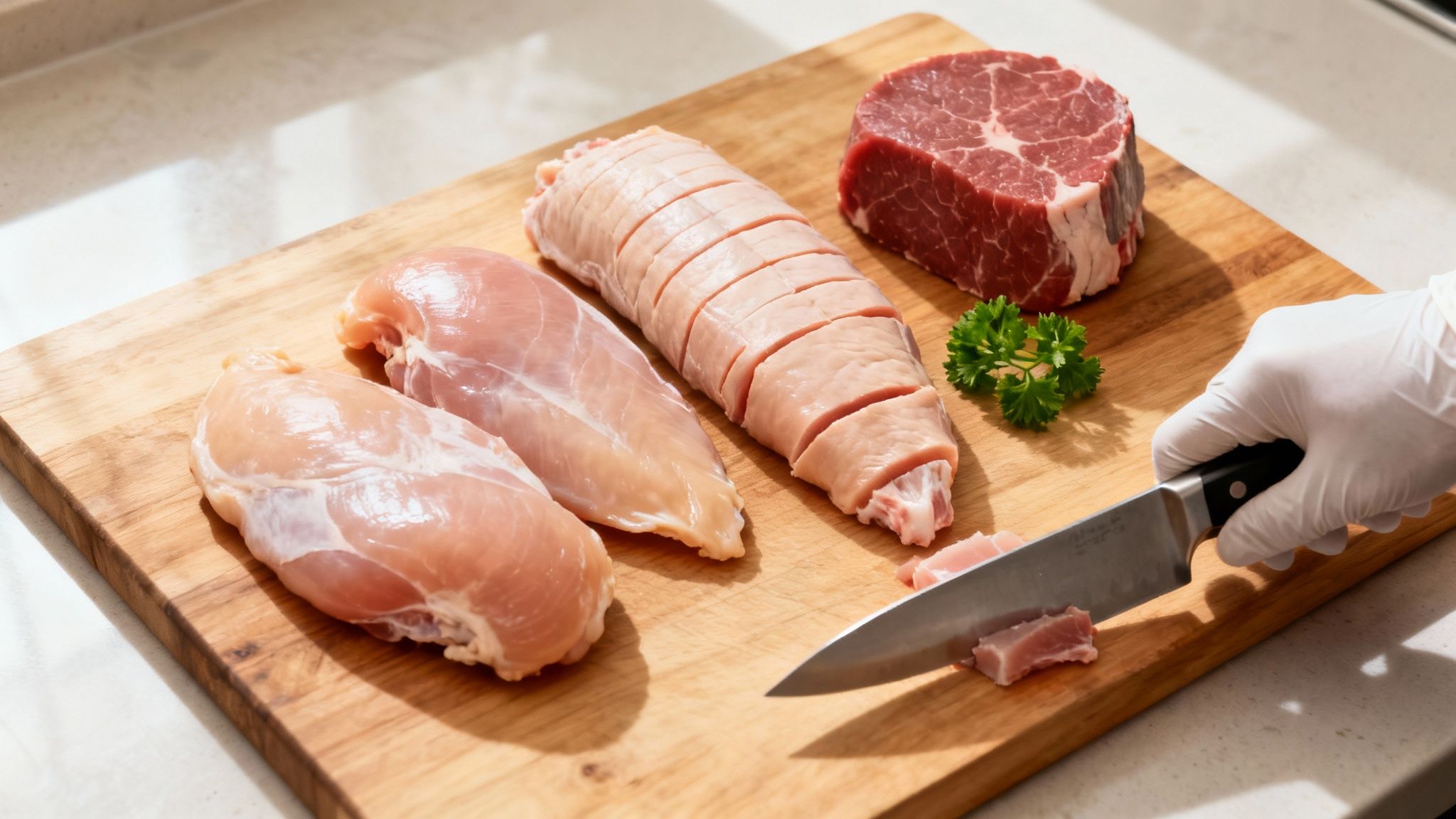
For an active, muscular breed like a Golden Retriever, lean protein is the gold standard.
Think of it this way: fat is the enemy of jerky. It does not dehydrate properly and can make the finished jerky spoil shockingly fast. Even more importantly, a high-fat diet can lead to serious health issues like pancreatitis in dogs, so trimming away every visible speck of fat is a crucial part of the prep work.
Golden-Approved Proteins
Your best bet is to go for lean cuts with very little marbling. When you are shopping, keep an eye out for these specific cuts. They are perfect for making jerky, easy to slice, have minimal fat, and dry out beautifully.
Here is a quick guide to my go-to proteins for making dog jerky. These cuts are not only safe and lean but also readily available at most grocery stores.
Safe Meats for Your Golden Retriever's Jerky
| Meat Type | Recommended Cut | Preparation Tip |
|---|---|---|
| Beef | Eye of round or top round | These cuts are incredibly lean and affordable. Ask the butcher for a "roast" cut for easier slicing at home. |
| Chicken | Boneless, skinless chicken breast | The classic choice for a reason. It is almost pure protein and makes for a light, crispy jerky. |
| Turkey | Turkey tenderloin or breast | A fantastic lean poultry alternative to chicken that is just as easy to work with. |
| Pork | Pork loin or tenderloin | Be extra diligent here. Pork loin often has a "fat cap" that you must trim off completely before slicing. |
After years of making these, I have found these four options to be the most reliable and produce the most consistent results. They are what I always come back to.
Remember, the goal is single-ingredient purity. You are creating a treat that is all about that pure, meaty flavor your dog naturally craves, without any of the confusing additives you are trying to avoid in the first place.
Seasonings: Safety First
I know it is tempting to add a little extra flavor, but when it comes to homemade dog jerky, less is always more. A dog's palate does not need the complex seasonings we enjoy, and many of the spices in our own cabinets are toxic to them. This is probably the most critical safety rule of all.
Absolutely Never Use:
- Onion or Garlic: Whether fresh, dried, or powdered, both are toxic to dogs and can cause serious health problems.
- Salt: Meat contains a natural amount of sodium. Adding extra salt is completely unnecessary and can be harmful to your dog's health over time.
- Spicy Peppers: Things like cayenne, chili powder, or paprika will only lead to digestive upset and irritation.
If you really want to add a little something extra, a tiny sprinkle of finely chopped fresh parsley is perfectly fine. But honestly? Your Golden will be more than thrilled with the pure, unadulterated taste of the meat itself. Keeping it simple is always the safest and healthiest approach.
How to Make Jerky Using Your Dehydrator, Oven, or Smoker
Alright, this is where the real fun starts. You have picked out the perfect lean protein, trimmed off all the fat, and now it is time to transform those beautiful cuts of meat into the chewy, delicious jerky your Golden is already dreaming about.
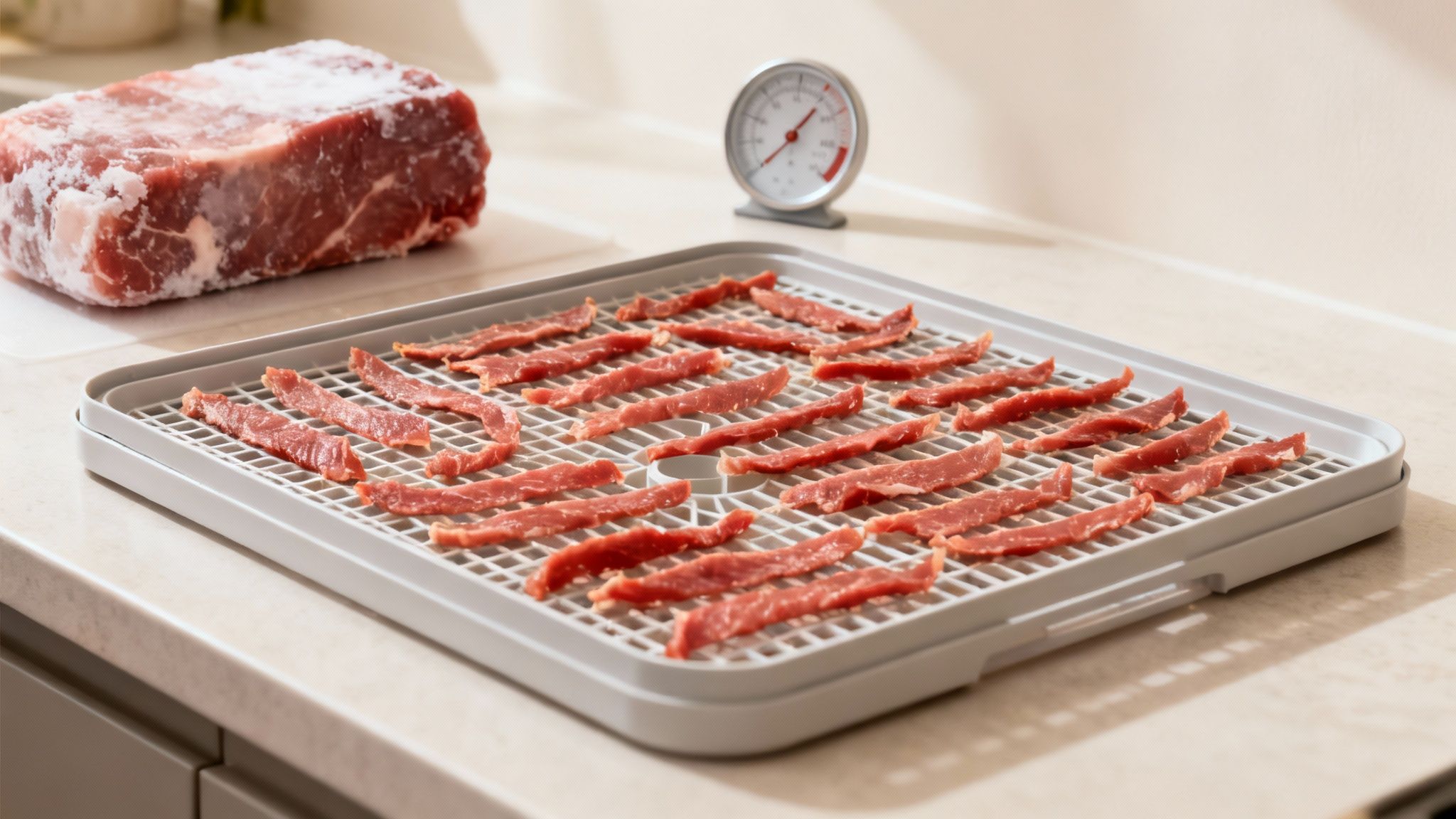
No matter if you are using a fancy dehydrator, your trusty oven, or a smoker, I have one universal tip that makes the whole process a lot easier: partially freeze your meat for about 30 minutes before you start slicing. This firms it up just enough to let you glide the knife through, creating those perfect, uniform strips that are the secret to even drying. I always aim for slices between 1/8 to 1/4 inch thick.
Ready to jump in? Making jerky can get a bit messy, so you might want to throw on an apron. If you have a furry "quality control supervisor" watching your every move like I do, a personalized Golden Retriever apron makes the whole experience even more fun.
The Dehydrator Method
Honestly, using a food dehydrator is the gold standard for homemade dog jerky. These machines are built for this exact purpose, circulating low, even heat to gently pull the moisture out of the meat without actually cooking it. It is pretty much foolproof.
Lay out your meat strips in a single layer across the dehydrator trays. The most important thing here is to make sure none of the pieces are touching or overlapping. Good airflow is everything. If they are crowded, you will end up with damp spots that will not dry correctly.
Set your dehydrator to 160°F (71°C). This is the magic number. It is hot enough to kill off any nasty bacteria but low enough to dry the meat into that perfect chewy texture we are after.
Drying time can vary quite a bit, but you are generally looking at 4 to 8 hours. The final time really depends on how thick you sliced your meat and which protein you used.
I always start checking the jerky around the 4-hour mark. You are looking for a texture that is leathery and tough, but still pliable enough to bend without snapping. If it breaks, it is overdone. If it still feels soft, it needs more time.
The Oven Method
No dehydrator? No problem at all. Your regular kitchen oven can do a fantastic job with just a couple of simple tweaks. The biggest challenge is making sure you are dehydrating the meat, not baking it.
The secret is all about creating airflow. Here is how you do it:
- Place your meat strips directly on an oven-safe wire cooling rack.
- Set that rack on top of a foil-lined baking sheet to catch any drips (this will save you a ton of cleanup time later).
- Prop the oven door open just a crack with a wooden spoon or wadded-up piece of foil. This lets all the moisture escape, which is critical for dehydration.
Set your oven to its lowest temperature, shooting for something between 160°F and 175°F (71°C to 79°C). If your oven’s lowest setting is a bit higher, that is okay. Just keep an extra close eye on the jerky so it does not cook too fast.
Oven-drying times are usually similar to a dehydrator, falling somewhere in the 3 to 8 hour range. Once again, it all comes down to the thickness of the meat, so start peeking in after 3 hours.
The Smoker Method
If you really want to make your Golden’s tail thump, using a smoker is an incredible option. This method gives the jerky a subtle, smoky flavor that dogs find absolutely irresistible. Just remember to keep things simple and safe for your pup.
When you are smoking jerky for your dog, do not use any intense, seasoned wood chips like mesquite or hickory. Instead, stick with mild fruitwoods like apple or cherry, and even then, use them very sparingly. The idea is to add a hint of smoke, not a full-on barbecue flavor.
Just like the other methods, arrange your meat strips on the smoker racks with plenty of space for air to move around. Keep the temperature low and steady at 160°F (71°C).
Smoking jerky is often a bit quicker, usually taking about 3 to 5 hours. Since smokers are designed for low-and-slow heat, they can be very efficient at drying thin strips of meat. Check for that classic, leathery texture, and you are good to go.
No matter which path you choose, you will end up with a batch of wholesome, single-ingredient jerky that you can feel amazing about sharing with your best friend.
Keeping Your Homemade Jerky Fresh and Safe
You have done it. The kitchen smells amazing, your Golden Retriever is practically glued to your side, and you have a beautiful batch of homemade jerky cooling on the rack. Before you give in to those pleading eyes, there is one final, crucial step you absolutely cannot skip: let the jerky cool completely.
I cannot stress this enough. If you seal up jerky while it is still even slightly warm, you are trapping moisture. That condensation creates the perfect environment for mold to grow, and all your hard work will go to waste. Patience here is key.
Once the strips are totally at room temperature, it is time to pack them up. The two biggest enemies of your jerky's freshness are air and moisture, so your storage mission is to keep them both out.
Your Best Storage Options
For everyday use, a simple airtight container works perfectly. I like to use glass jars with good seals for the jerky I know we will use up in the next week or two. They are easy to grab from for a quick training session or a walk.
But for long-term storage? A vacuum sealer is your best friend. Removing all the air from the bag is the single best way to dramatically extend the jerky’s shelf life and lock in that savory flavor your dog loves.
I will often spend a Sunday afternoon making a huge batch of chicken or beef jerky. I will fill up one small jar for the week ahead and then vacuum-seal the rest in smaller, portioned-out bags. I just toss them in the freezer, and I have high-value treats ready to go for months.
How Long Does Homemade Jerky Last?
Because we are skipping all the artificial preservatives you find in commercial treats, our homemade jerky has a shorter shelf life. That is a good thing! But it means storing it properly is non-negotiable.
Here is a good rule of thumb for jerky that has been properly dried:
- In the Pantry: Kept in a truly airtight container, it should last for up to two weeks.
- In the Refrigerator: You can extend its life to one to two months.
- In the Freezer: When vacuum-sealed, your jerky will stay good for six months or even longer.
This simple system makes it easy to always have a healthy, safe reward ready for your best friend. And while you are getting your jerky station organized, one of our durable Golden Retriever tea towels is perfect for keeping your kitchen tidy. When you store your jerky correctly, you can be sure that every single piece you give your dog is as fresh and delicious as the day you made it.
Turning Your Jerky into a Special Treat (or a Perfect Gift!)
Making a big batch of jerky is one thing, but the real fun starts when you see that tail start to thump. This is where all your effort pays off in pure, unadulterated Golden Retriever joy. Let's talk about how to serve it up right and even share the love with other dog owners.
How Much Jerky Should My Golden Get?
First, a quick reality check: homemade dog jerky is a treat. It is a super-special, high-value reward, not a substitute for their regular food. Since it is pure, concentrated protein, a little goes a long way. That is a big deal for Goldens, who can pack on the pounds if we are not careful.
I save jerky for the big wins, like when we finally nail that "stay" command with distractions or for being a champ at the vet. For my adult Golden, one or two medium strips a day is the absolute max. If you have a growing puppy, just a tiny piece is more than enough to make their day without overwhelming their little digestive system.
I always tuck a few extra pieces of jerky into my pack when we go for a long hike. It is the perfect lightweight, high-energy trail snack to give my guy a little boost when he has been climbing and swimming for a couple of hours.
Getting Creative With Dog-Safe Flavors
Plain jerky is always a hit, but sometimes it is fun to mix things up. A little touch of a dog-safe ingredient can add some interesting flavor and bonus nutrients. Your Golden will definitely appreciate the variety.
Here are a few simple ideas I have tried:
- A Hint of Pumpkin: Before you start drying, brush a super-thin layer of 100% pure pumpkin puree (the plain stuff, not the spiced pie filling!) onto the meat strips. It is fantastic for their digestion.
- Sweet Potato Smear: Just like pumpkin, a light coating of plain, mashed sweet potato adds a bit of natural sweetness and some extra vitamins.
- Parsley for Fresh Breath: A tiny sprinkle of finely chopped fresh parsley before dehydrating can actually help with doggy breath. A little goes a long way here.
Just remember to introduce any new ingredient slowly. What one dog loves, another might not tolerate as well, so always watch for any signs of an upset tummy.
The Perfect Gift for Dog Lovers
Honestly, there is no better gift than something you made with care. A jar of homemade jerky is one of the most thoughtful presents you can give a fellow dog person. It says, "I love your dog, too!"
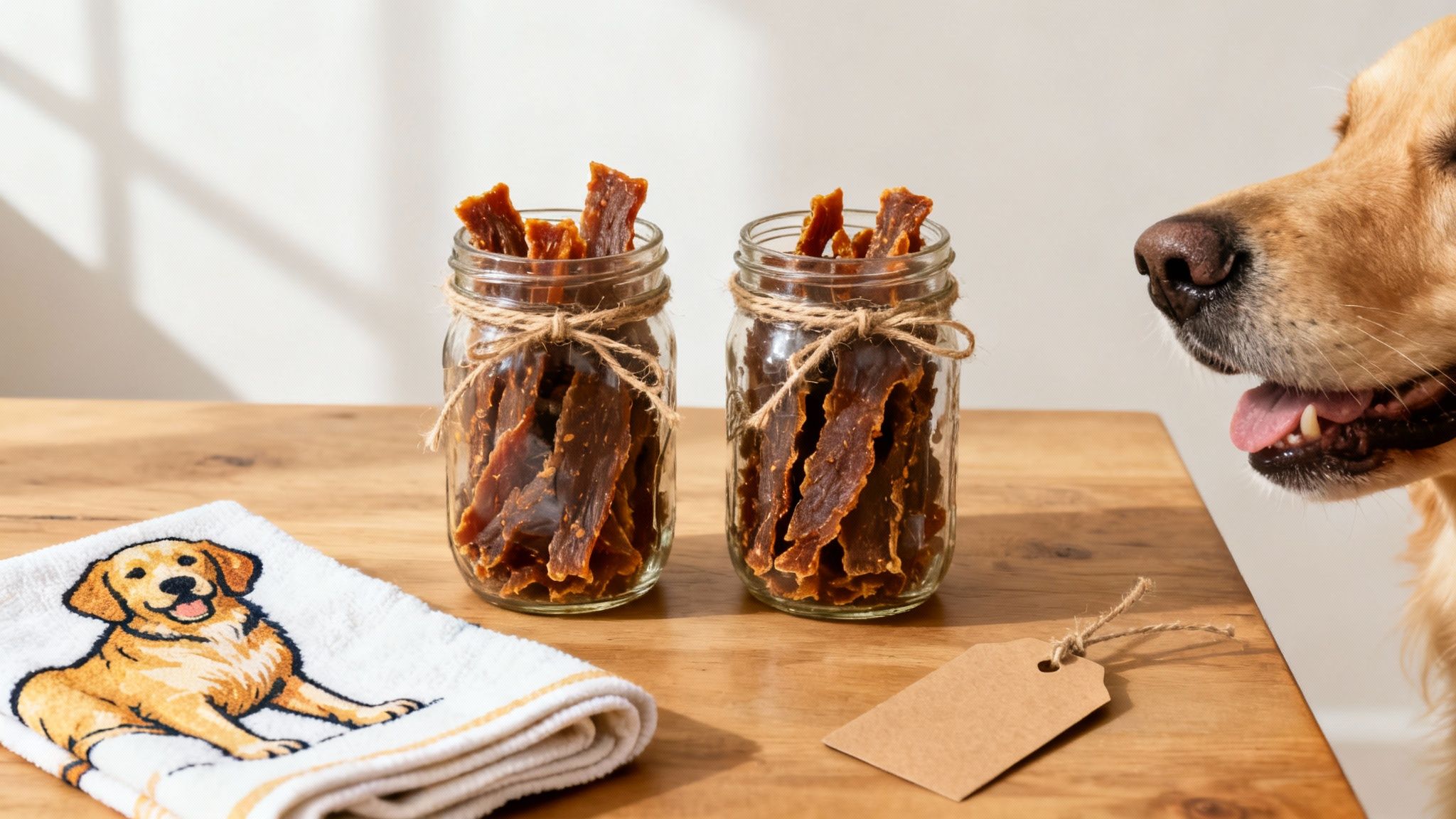
Making it look special is easy. Just pop the cooled jerky into a clean mason jar, tie some twine or a nice ribbon around the top, and you are set. I like to add a little tag with the dog's name and the date I made the treats, just so they know it is fresh.
Want to take it a step further for a fellow Golden owner? Put together a small gift basket. Pair your jar of jerky with a fun, breed-specific item, like a cozy Golden Prints mug or a cute kitchen towel. It turns a simple, tasty treat into a truly heartfelt gift that celebrates the goofy, lovable breed we are all obsessed with. For more ideas, check out some of the best gifts for dog owners in our guide.
Answering Your Homemade Dog Jerky Questions
Even after you have pulled a perfect batch of jerky from the dehydrator, a few questions might still be nagging you. That is completely normal. It takes a little practice to get the hang of it, and you want total peace of mind that you are giving your Golden a treat that is both delicious and safe.
Let's tackle some of the most common uncertainties that pop up when you are just starting out.
How Do I Know for Sure When the Jerky Is Done?
You are looking for a specific texture. The perfect piece of jerky should feel tough and leathery. If you can press into it and it feels soft or squishy, it is not done yet.
It should be pliable enough to bend without snapping in half. If it does snap easily, it is a bit over-dried, but do not worry, your dog will still think it is the best thing ever. The most critical safety check is feeling for any cool or damp spots. Those are red flags that moisture is still trapped inside, and it needs more time in the dehydrator.
For an extra layer of safety with chicken or turkey, I sometimes pre-cook the thin strips. Just pop them in a 165°F (74°C) oven for a few minutes before you start dehydrating. This quick step kills off any surface bacteria right at the start.
Can I Use Ground Meat for Jerky?
Absolutely! Using ground meat is a fantastic option, especially if you have an older dog or a young pup. It creates a softer, easier-to-chew jerky.
You will want to get a jerky gun for this. It works a lot like a caulking gun, letting you press out perfectly uniform strips. Just be sure to use very lean ground meat, something like 93% lean or higher, to keep the fat content down.
Because ground meat has so much more surface area, you have to be extra careful to dry it completely. Pay close attention to your drying times and be diligent about how you store it to keep it fresh and safe.
Your own senses are the best tool you have. If your stored jerky ever smells off, looks moldy, or feels weirdly soft or tacky, throw it out immediately. When in doubt, it is always better to be safe than sorry.
Is Homemade Jerky Safe for My Golden Retriever Puppy?
This is a really important question, and the first person you should ask is your vet. Puppies have sensitive digestive systems and developing teeth that can be easily overwhelmed.
If your vet gives you the go-ahead, start with jerky made from ground meat or very thin, small pieces of whole muscle to minimize any choking risk. And, of course, always supervise your puppy when they are enjoying their new favorite treat. Remember, jerky is a high-value snack, so moderation is key for a growing dog.
At Golden Prints, we believe the love you pour into things like making homemade treats is what makes life with a Golden Retriever so incredible. We celebrate that bond with our collection of cozy apparel and home goods made for people who know their dog is family. You can explore the full collection at https://www.goldenprintsonline.com.


